
TENS, EMG and AI in Full-Arch Rehabilitation: Evidence and Clinical Boundaries
Does combining TENS, EMG and AI establish a more reliable full-arch bite? The tools serve different functions. Evidence for a short-term muscle response or a software-registration task is not evidence that the combined workflow improves implant survival. Start with the clinical problem and ask what each component has actually been shown to do. TENS study; implant-occlusion consensus.
Separate the jobs of the different tools
- Surface EMG records electrical activity from accessible muscles during specified tasks. It does not directly measure implant loading or independently diagnose the cause of pain.
- TENS applies electrical stimulation. Studies in selected TMD populations have assessed short-term pain, muscle activity or mandibular posture; these outcomes do not establish an ideal full-arch restorative position.
- Digital jaw-relation records describe a relationship that still needs clinical verification.
- AI-assisted software may support a defined data-processing or registration task. Each application needs evidence for its intended use.
These distinctions are educational interpretations of diagnostic-accuracy research, a TENS trial and an AI-assisted registration study. Combining outputs is a proposed workflow, not proof of improved clinical outcomes.
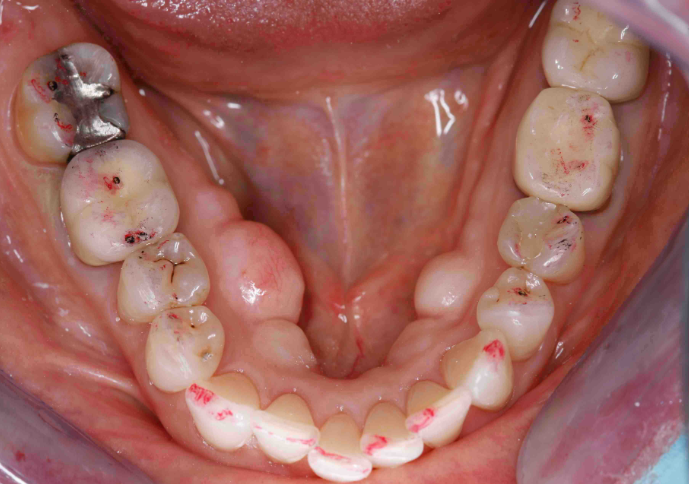
Occlusal markings on a natural dentition illustrate contact assessment. This image is not a documented full-arch implant case or proof of TENS–AI benefit.
What can the TENS evidence support?
A randomized study of 40 patients with myofascial TMD evaluated a single 50-minute sensory-stimulation session and outcomes through 48 hours. A different controlled study of 60 selected women with TMD in remission evaluated one 60-minute session and found changes in selected resting sEMG measures and vertical interocclusal distance. Neither study evaluated full-arch implant survival or validated a universal restorative bite position. Ferreira and colleagues; Monaco and colleagues.
For chronic TMD pain of at least three months, the BMJ guideline conditionally recommends against TENS. That therapeutic recommendation should not be indiscriminately extended to every prosthodontic indication. Equally, a short-term response should not be presented as justification for irreversible bite-changing treatment for TMD. NIDCR guidance.
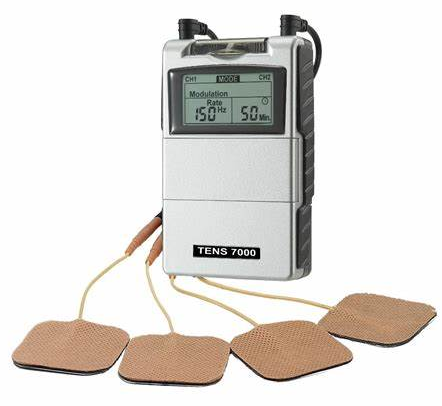
A generic TENS unit is pictured. This image does not establish suitability for dental stimulation; the exact device’s intended use, safety screening and instructions must govern any use.
What has AI been tested to do?
One 2026 validation study used 40 paired CBCT and intraoral-scan datasets to evaluate AI-assisted image fusion and occlusal reconstruction from scan relationships. That defined geometric task does not establish autonomous TENS-guided adjustment, measured bite-force redistribution or improved implant survival. Read the original validation study.
What still needs clinical verification in a full-arch case?
An American College of Prosthodontists best-evidence consensus found insufficient evidence for a single implant occlusal scheme that minimizes or eliminates complications. This does not make occlusal assessment irrelevant; it argues against promising that one scheme or device combination guarantees success. Goldstein, Goodacre and Taylor.
- For the dentist: establish the patient-specific prosthodontic plan and verify the clinical records used to construct it.
- For the laboratory: identify which records are clinical measurements, which are software-derived relationships and which have been approved for design.
- At delivery and review: assess the prosthesis clinically and follow the maintenance plan. Do not substitute a muscle index or an attractive software display for those checks.
These are DDS teaching interpretations of the limits of the cited evidence, not new trial findings or universal fabrication settings.
What should you ask before buying an integrated system?
Ask for the authorized indication, the quantity measured, evidence in the intended patient population, integration/export requirements, training and current total costs and support. A vendor must identify the actual device and software version; an unverified product name or price is not a clinical comparison.
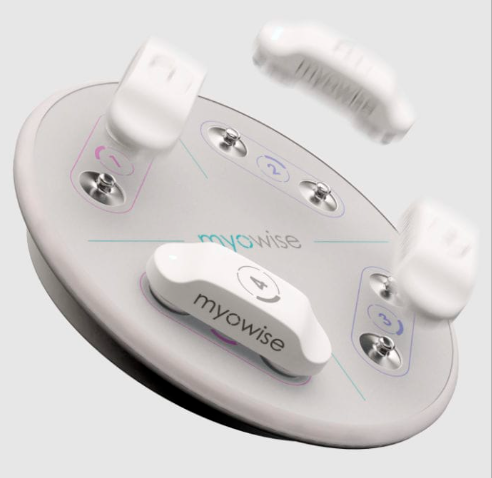
MyoWise hardware is an example of a dental EMG system. Official product information describes the instrument; it does not demonstrate an integrated TENS–AI implant-survival benefit.
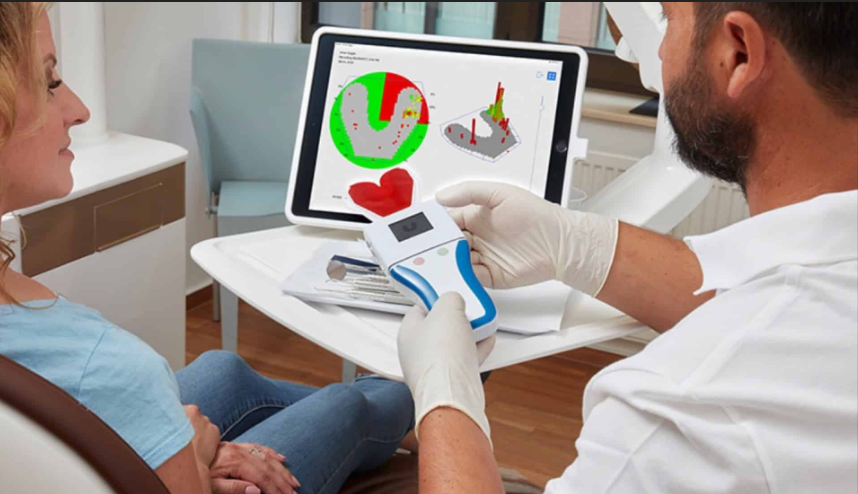
An instrument display is shown during an occlusal assessment. Do not interpret this illustration as evidence of the proposed integrated TENS–EMG–AI workflow or a documented treatment outcome.
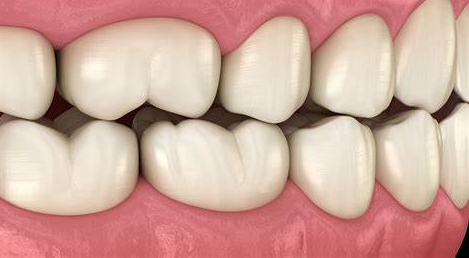
Illustration of opposing teeth, included only as a visual reference for the occlusal relationship; not a patient outcome.
What evidence would justify a stronger claim?
A clinically useful validation would identify the actual integrated protocol, target patients, comparator, adverse effects and follow-up. It would measure meaningful patient or prosthesis outcomes rather than only signal changes or image alignment. This is an educational proposal for evaluating evidence, not a claim that such a trial has already established the article’s original promises.
The practical conclusion
Digital tools may assist selected components of full-arch planning and documentation. Clinical decisions still require patient-specific assessment, verification of records and follow-up. The evidence reviewed here does not establish that an integrated TENS–EMG–AI workflow extends implant longevity.
Sources and further reading
- Ferreira and colleagues: short-term TENS randomized trial, 2017
- Monaco and colleagues: TENS, muscle activity and interocclusal distance, 2013
- Goldstein, Goodacre and Taylor: implant occlusion best-evidence consensus, 2021
- Original AI-assisted CBCT/intraoral-scan registration study, 2026
- Diagnostic-accuracy study of sEMG and jaw tracking, 2011
- BMJ guideline for chronic TMD pain, 2023
- NIDCR: Temporomandibular Disorders