
Milled vs conventional PMMA: What determines full-arch interim strength?
Is milled PMMA always the stronger choice? One relevant laboratory comparison favored its standard milled design, but the connection and cantilever configuration changed the result. Start with the exact material and prosthesis design, then ask which evidence applies to the restoration you intend to deliver. [1]
This guide connects the strength question to published clinical workflows. Laboratory measurements, manufacturer specifications and patient follow-up answer different questions. Reading them together helps the dentist and dental technician select a provisional material, assess the prosthesis design and plan the delivery appointment.
What are we actually comparing?
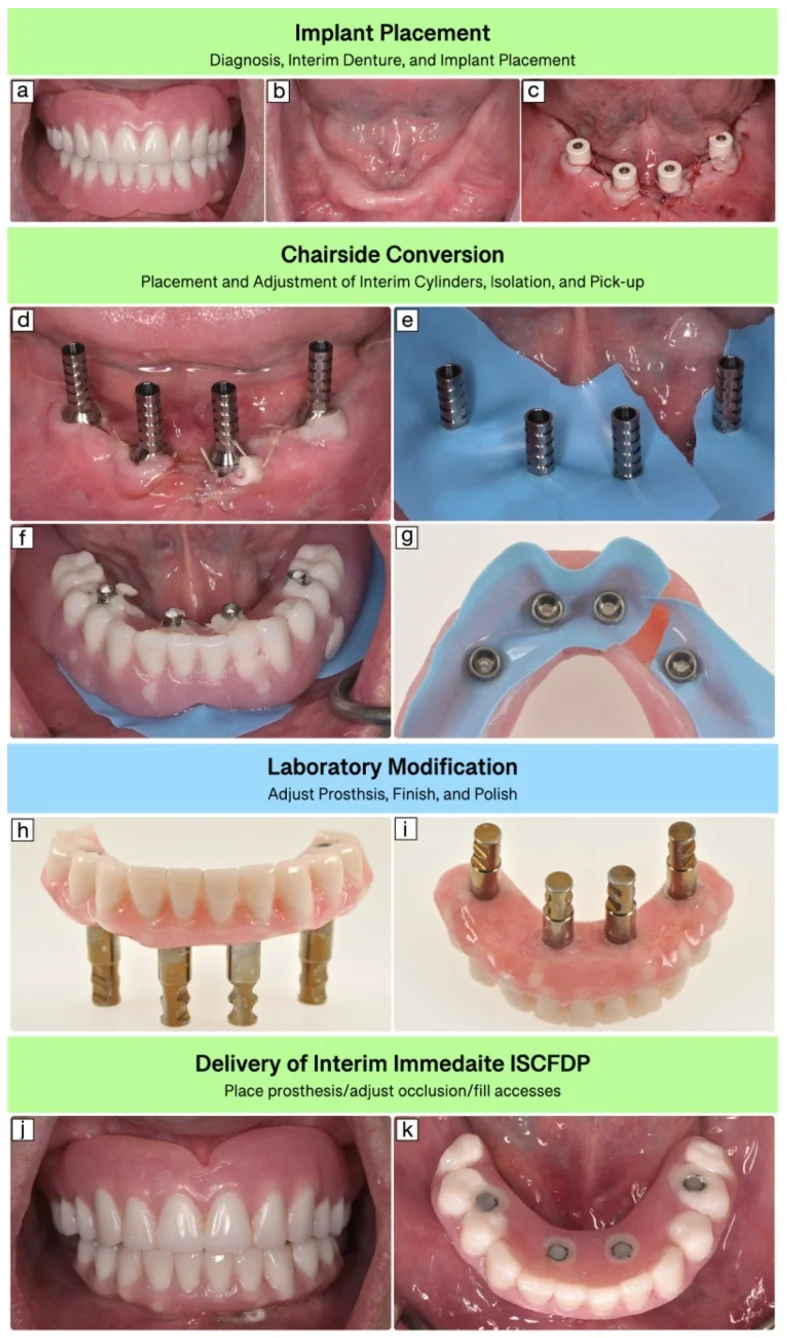
A manufacturing method and a connection technique describe different parts of the restoration. One clinical report [2] describes designing and milling an interim from a prepolymerized PMMA disk. Separate clinical cases [3] show chairside conversion, in which resin connects a provisional denture to temporary cylinders; their guided case also uses intraoral pickup.
When reading a paper or preparing a laboratory prescription, specify three things: the bulk material, how the prosthesis body is made, and how it connects to the abutments. “Digital” and “conventional” alone do not identify a like-for-like comparison.
Does the prosthesis design change its strength?
The laboratory study compared simulated heat-processed and milled structures with different coping designs [1]. Noncantilever strength and cantilever failure load are separate endpoints:
On a narrow screen, scroll this table horizontally to read every column. Keyboard users can focus the table region and use the arrow keys.
| Study group | Noncantilever flexural strength MPa, mean ± reported spread | Cantilever failure load N, mean |
|---|---|---|
| Heat-processed PMMA | 91.35 ± 18.92 | 512.66 |
| Standard milled PMMA | 143.94 ± 36.79 | 695.06 |
| Low-profile-coping milled PMMA | 117.06 ± 13.86 | 254.97 |
Source: [1], Results. The abstract does not define the ± measure, so it is reproduced without labelling it a standard deviation. These are specimen results, not universal material specifications or patient survival rates.
The low-profile group illustrates why a manufacturing label alone is insufficient. Its cantilever result differs from the standard milled group’s result. Ask whether the study’s connection and geometry resemble the proposed restoration before transferring its ranking.
What do the clinical cases show?
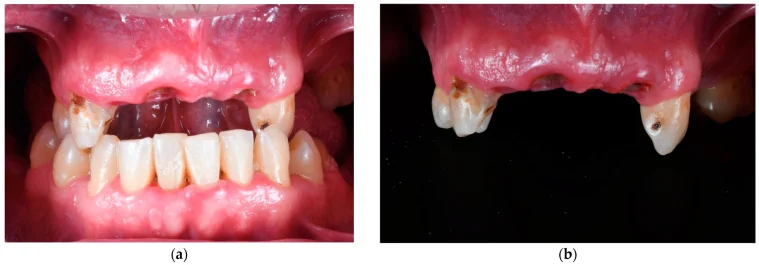
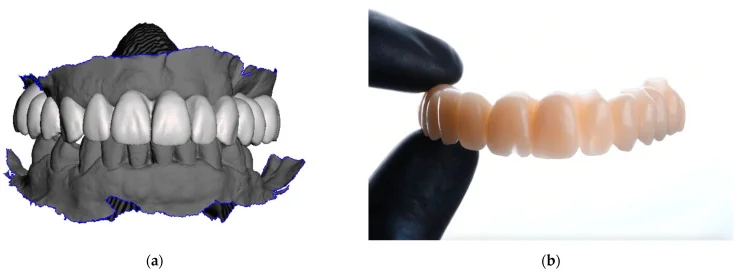
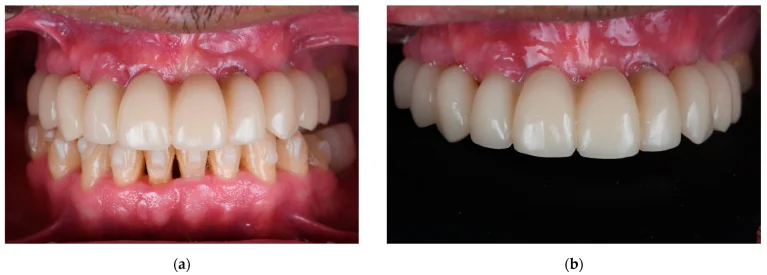
Follow the patient photographs alongside the laboratory design and delivery stages. They do not measure the strength difference in the table. The first three figures follow one patient; the two conversion sequences show separate patients.
Published clinical workflow examples
These published source examples illustrate clinical and laboratory workflows. They are not DDS-treated cases, a head-to-head strength comparison, or evidence of long-term superiority.
Case sequence 1: milled PMMA interim
The following three figures show the same source example, from initial views through digital design to its three-month review. The study had no conventionally processed PMMA comparison group.
Case sequence 2: chairside denture conversion
This is a separate published source case. Chairside conversion with autopolymerizing resin is not a controlled comparison of bulk heat-processed and milled PMMA.
Case sequence 3: guided conversion in a different patient
This figure shows a different source patient from the conventional-conversion example above, not a before-and-after comparison. The clinical panels include surgical views.
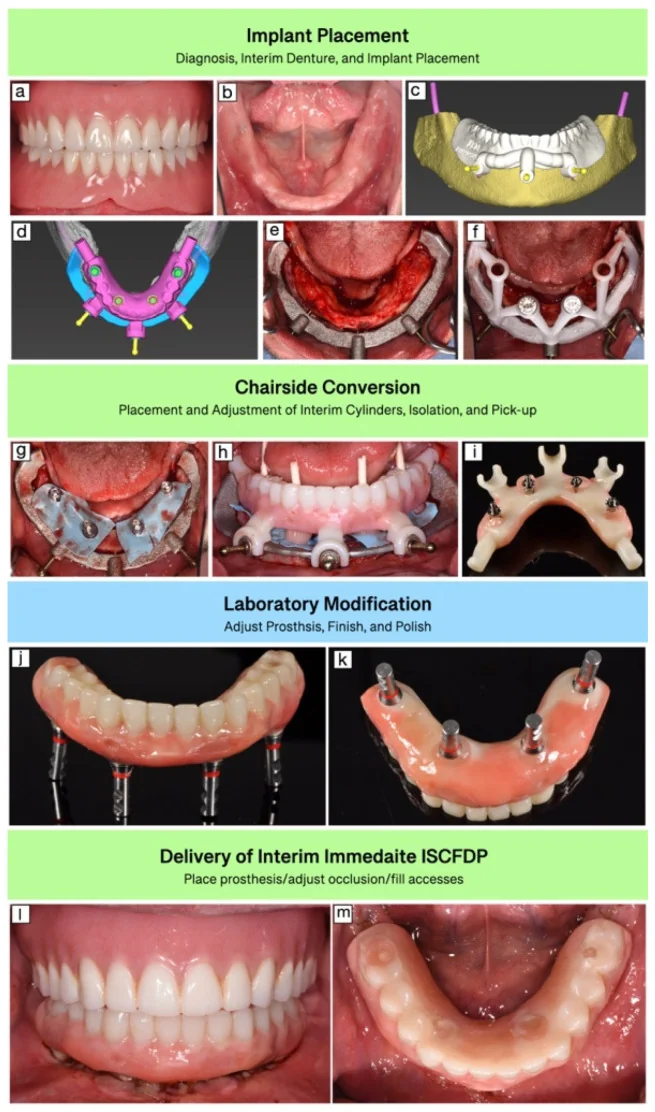
The three-month review cannot show how this patient would have performed with another material. Likewise, the two conversion cases illustrate techniques in different patients; they do not establish which technique produces the stronger prosthesis.
Which material is suitable for this provisional?
First confirm the product category. Ivoclar describes SR Nexco as a light-cured laboratory composite. It should not be listed as a PMMA milling blank.
VITA’s CAD-Temp instructions, page 3, describe a microfilled acrylate polymer and report flexural strength above 80 MPa under the manufacturer’s test conditions. Its temporary crown-and-bridge indication includes bridge spans up to two pontics, with further time and design limits in the IFU. That specification is not blanket validation for a complete-arch implant-supported design.
Build the prescription around the exact product’s intended use and compatible design. Record the blank or processing resin, connection components and fabrication route. If these are unspecified, obtain them before treating a brand name, machine family or generic strength range as a recommendation.
Scroll the checklist table horizontally on narrow screens. The action belongs to the responsible clinician and laboratory; no universal fabrication settings are supplied.
| Check | Question to resolve | If the answer is missing |
|---|---|---|
| Material identity | What exact product and current IFU apply? | Obtain the product documentation |
| Intended design | Does the stated indication cover this restoration? | Resolve with the clinician and laboratory |
| Evidence match | Are material, connection, geometry and endpoint comparable? | Do not transfer the study ranking unchanged |
| Delivered fit | How will the completed prosthesis be assessed clinically? | Do not substitute a machine-tolerance number |
| Service plan | What checks and maintenance are planned? | Document the plan rather than assuming milling removes follow-up |
Does a smoother surface improve patient outcomes?
Surface findings are material- and test-specific. In an in-vitro study, researchers [4] compared disk specimens of six dental polymers before and after thermocycling. The tested CAD/CAM denture and temporary polymers showed lower Staphylococcus aureus and Candida albicans adhesion than their respective conventional groups. This laboratory finding does not establish lower peri-implant infection rates or universal superiority for full-arch interims.
Fit remains a separate question. The published clinical workflow [2] included post-milling adjustment before delivery and clinical assessment afterward. A machine’s nominal tolerance cannot replace evaluation of the completed restoration. There is no supported universal ±20 µm or ±40–60 µm delivered-fit comparison established by the sources used here.
What is the take-home message?
A stronger PMMA specimen does not automatically mean a stronger full-arch provisional. The material, temporary-cylinder region and distal extension must be considered together. For the laboratory, that means a clear material-and-design prescription. For the dentist, it means assessing the delivered prosthesis and reviewing the patient rather than relying on the word “digital”.
From evidence to everyday digital dentistry. At Digital Dentistry Schoology (DDS), our educational aim is to connect published research with the decisions dentists and dental technicians face in implant prosthodontics, digital occlusion and CAD/CAM practice. This article brings the relevant studies together to make that discussion clearer.
Primary sources
- Angelara K, Bratos M, Sorensen JA. Comparison of strength of milled and conventionally processed PMMA complete-arch implant-supported immediate interim fixed dental prostheses. Journal of Prosthetic Dentistry. 2023;129(1):221–227. Study and DOI.
- Garza LC and colleagues. Evaluation of Polymethyl Methacrylate as a Provisional Material in a Fully Digital Workflow for Immediate-Load Complete-Arch Implant-Supported Prostheses over Three Months. Materials. 2025;18(3):562. Study and DOI.
- Nagai and colleagues. Conversion Techniques for Immediate-Loading Interim Implant-Supported Complete-Arch Fixed Dental Prostheses (ISCFDPs): Four Clinical Reports. Dentistry Journal. 2026;14(6):350. Article and figure source.
- Wei X, Gao L, Wu K, et al. In vitro study of surface properties and microbial adhesion of various dental polymers fabricated by different manufacturing techniques after thermocycling. Clinical Oral Investigations. 2022;26(12):7287–7297. Study and DOI.
- Ivoclar: SR Nexco product description.
- VITA CAD-Temp instructions for use, material/processing requirements and intended use, page 3.
Clinical image credits
Figures 1–3: © 2025 the authors of reference 2, original Figures 1–3. Figures 4–5: © 2026 the authors of reference 3, original Figures 1–2. All five images are reproduced under CC BY 4.0. Each image links to its original source figure. Image content is unchanged; WebP compression only. Accessed 2 October 2026. These are published source cases, not patients treated by DDS; no author or journal endorsement is implied.