
Dynamic Occlusal Adjustments in Prosthodontics
When does a bite finding justify changing a restoration? Dynamic occlusal assessment examines contacts as the jaw moves. Selective adjustment is a separate intervention: removing tooth or restorative material is irreversible. Begin with the restorative problem, the patient’s symptoms and a documented examination, rather than treating a digital display or a response to stimulation as an instruction to adjust.
For a crown, bridge or larger rehabilitation, decide whether the restoration should conform to the existing occlusion or whether a planned change is needed, and communicate that decision through appropriate clinical records. This is different from changing the bite to treat temporomandibular disorders (TMDs). Restorative planning review.
Start with the complaint and the restorative indication
Ask what the patient experiences, when it began and whether it followed delivery of a restoration. Examine the restoration and the wider clinical picture. Pain, restricted movement and a perceived change in the bite deserve assessment; none establishes its cause on its own. The DC/TMD framework combines symptom history, examination and relevant psychosocial assessment. DC/TMD recommendations.
- Restorative contact problem: document a reproducible discrepancy in the context of the intended restoration and occlusal scheme.
- Pain or limited function: assess the presenting disorder rather than assuming that an occlusal interference explains it.
- Discomfort without a corresponding clinical finding: reassess before further adjustment. The Japan Prosthodontic Society cautions that adjustment without an identified occlusal problem may fail to help and may worsen discomfort. Position paper.
For TMD specifically, NIDCR reports insufficient evidence that treatments which permanently change teeth or the bite are effective, with possible worsening in some cases. That warning concerns TMD treatment; it does not remove the need to manage a separately established restorative defect. NIDCR guidance.
Choose the record for the question
Digital records can help the clinician and laboratory inspect geometry and communicate a plan. Keep the different measurements separate:
- Intraoral scans: surface models and registered relationships between the arches. A scan-based contact display is not, by itself, a recording of bite force or muscle activity.
- Occlusal sensors: systems such as T-Scan record bite-sequence timing and force information. This is the manufacturer’s description of a measurement, not proof that a TENS-assisted adjustment improves clinical outcomes. Device function.
- Surface electromyography: electrical activity sampled from muscles under specified recording conditions. It does not directly measure restoration fit.
- Jaw-motion records and simulations: recorded or modelled movement. The validity of a simulated contact depends on the input records and the model’s assumptions.
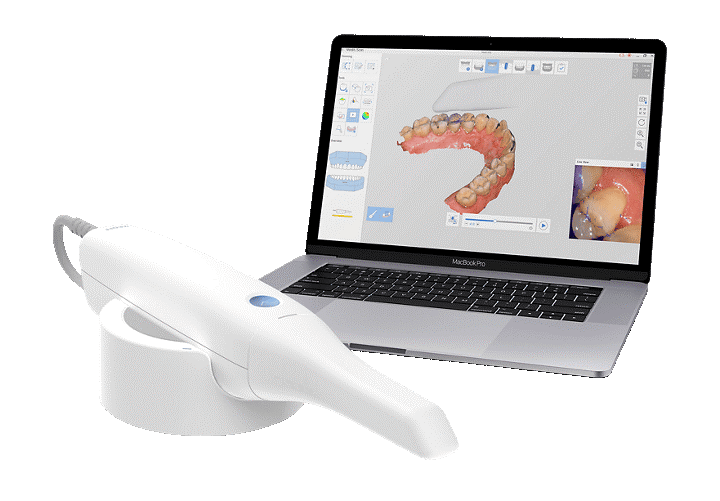
Intraoral scanner and digital dental model. The illustration shows surface-record acquisition; it does not demonstrate pressure measurement, TENS feedback or an achieved treatment result.
In a prospective study of 28 records, contacts recorded with an intraoral scanner differed from photographed articulating-paper marks, and clinicians showed low agreement when judging the records. Neither a convincing colour map nor a single marking should be treated as a self-explanatory treatment decision. Esposito and colleagues, 2024.
Make the clinical decision before modifying a surface
A useful restorative assessment links three things: the intended occlusal scheme, repeatable clinical findings and the patient’s functional complaint. Record contacts in closure and excursions in the context of that plan. If the records disagree, resolve the discrepancy before committing to a material change. These are clinical planning principles, rather than a universal contact pattern for every prosthesis. Crown and bridge planning.
For implant-supported restorations, a best-evidence consensus found insufficient evidence to identify an occlusal scheme that minimizes or eliminates complications. Avoid promising implant protection or long-term stability from a particular contact pattern, sensor reading or TENS-derived position. Goldstein, Goodacre and Taylor, 2021.
When a restorative adjustment is clinically indicated, its extent and the subsequent surface finishing depend on the restoration, material and treatment plan. Assessment should also consider repair or remake when adjustment would compromise the restoration. The decision belongs to the treating clinician; an automated recommendation does not replace it. Clinical review of implant-restoration maintenance.
What can TENS add, and what has actually been tested?
Transcutaneous electrical nerve stimulation (TENS) delivers electrical impulses through skin electrodes. Studies have examined pain, muscle activity and mandibular posture. A change in any one of these outcomes does not establish a uniquely correct position for definitive restorations.
- Muscle activity and rest position: Monaco and colleagues studied one 60-minute session in 60 young women with unilateral TMD in remission. Resting muscle activity and interocclusal distance changed; the trial did not test definitive restorative bite accuracy. Controlled trial.
- Short-term pain outcomes: Ferreira and colleagues compared active and placebo TENS in 40 people with myofascial TMD, immediately and at 48 hours. Pain-intensity scores did not differ between groups at any assessment, although some pressure-pain-threshold and muscle-activity findings differed. Randomized trial.
- Restorative interpretation: a 2026 evidence map describes physiological and functional signals but does not establish a universally validated restorative jaw position. These findings should not be turned into promises of fewer adjustment visits or durable prosthetic success. Evidence map.
For adults with moderate chronic TMD pain lasting at least three months, the 2023 BMJ guideline conditionally recommends against TENS. It favours several options, including supervised jaw exercise and stretching, manual trigger-point therapy and usual care such as education. The recommendation does not address acute TMD pain and is not a universal contraindication. BMJ guideline.
Keep AI-assisted proposals within their demonstrated role
Automating a digital model or suggesting a surface change is different from safely controlling electrical stimulation or deciding to remove tooth structure. The TENS studies above did not test an AI system that automatically selects stimulation settings and then directs occlusal adjustment.
Before relying on a proposed integrated system, ask for the exact device and intended use, validation in comparable patients, the clinician’s review and override process, and measured patient outcomes. An attractive simulation or a lower muscle-activity reading cannot establish that the system improves pain, restoration survival or long-term function.
Carry a clear record through to review
The practical handoff is a documented clinical question, interpretable records and a specified restorative goal. For the dentist and laboratory:
- Identify the restoration and the finding being addressed; do not use an unnamed ideal bite as the treatment target.
- Label what each record measures and record acquisition conditions, so the laboratory can distinguish a surface model from a motion or sensor record.
- Document any material modification and review the restoration and patient-reported function afterwards.
- If pain persists or the findings do not explain the complaint, reassess the diagnosis and seek appropriate expertise rather than repeatedly adjusting to chase symptoms.
These are teaching takeaways from the restorative-planning and diagnostic sources above. Digital tools are most useful when they clarify a defined question and their outputs remain subject to clinical verification.
Sources and further reading
- Crowns and other extra-coronal restorations: occlusal considerations and articulator selection (2002)
- Schiffman and colleagues: Diagnostic Criteria for Temporomandibular Disorders (2014)
- Tamaki and colleagues: Japan Prosthodontic Society position paper on occlusal discomfort syndrome (2016)
- NIDCR: Temporomandibular Disorders
- Esposito and colleagues: reliability of scanner and articulating-paper contact records (2024)
- Occlusal considerations in maintaining health of implants and their restorations (2024)
- Goldstein, Goodacre and Taylor: occlusal schemes for implant restorations, best-evidence consensus (2021)
- Monaco and colleagues: controlled TENS trial (2013)
- Ferreira and colleagues: short-term TENS randomized trial (2017)
- Sadek and colleagues: TENS/EMG-guided positioning evidence map (2026)
- Busse and colleagues: BMJ chronic TMD pain guideline (2023)
- Tekscan: manufacturer description of T-Scan bite timing