
Digital Guides for Occlusal Rest-Seat Preparation in Removable Partial Dentures
An occlusal rest needs a seat that supports the removable partial denture (RPD), provides room for the rest, and respects the remaining tooth structure. The clinical challenge is to translate that design into a preparation with the intended position and form. A digital guide may help with this transfer, provided the RPD design, guide fit, and completed preparation are checked.What must the rest seat achieve?
The rest is the part of the framework that contacts the prepared seat on an abutment tooth. It contributes vertical support and transfers part of the load through that tooth. Its position must therefore be planned with the rest of the RPD, including the supporting teeth, denture base, clasp assembly, and path of placement. A guide is designed around these clinical decisions. Read about occlusal rest function.For a conventional posterior occlusal rest seat, the usual design has a rounded triangular outline and a smooth, concave floor. The preparation should provide space for the planned rest without creating an occlusal interference or unnecessary loss of tooth structure. Check the opposing contacts and the condition of the tooth or existing restoration before deciding how much preparation is appropriate. See the rest-seat preparation principles.Dimensions must suit the tooth, available restorative space, framework material, and prosthetic design. Laboratory analysis by Sato and colleagues shows that rest geometry affects mechanical strength, but it does not supply a single preparation depth for every patient. A digital template should reproduce the individual clinical design. Sato et al., 2003.Where can a digital guide help?
A rest-seat guide provides a physical reference for transferring a CAD preparation plan to the tooth.Yu, Wen, and Wu described a cobalt-chromium template with a guide rail and bur-stop arrangement. Their dental technique report explains the method without comparing treatment outcomes in a clinical trial. Read the technique report.Bai and colleagues compared titanium template-guided and freehand rest-seat preparation on identical gypsum casts. With the trained operator and conditions tested, guided preparations had better measured accuracy, shape, and position. This was an in vitro study: it supports the technique’s laboratory potential but does not establish patient comfort, shorter appointments, or long-term RPD survival. Read the laboratory study.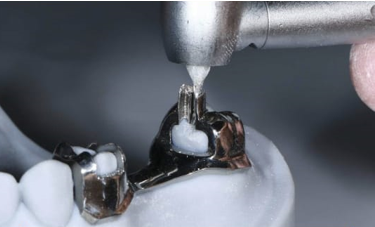
How should the guide be designed and manufactured?
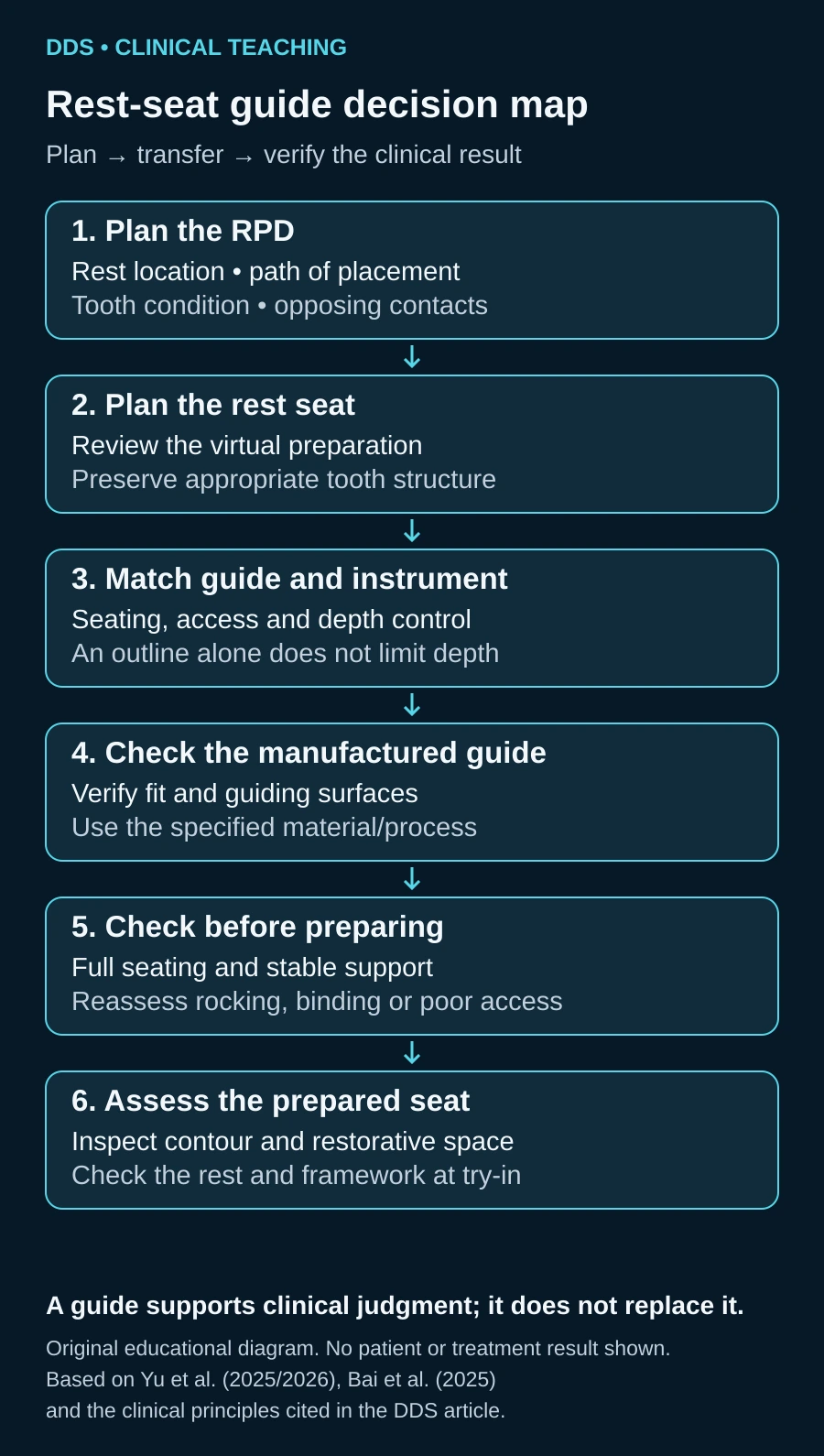
1. Establish the RPD design and preparation limits
Survey the diagnostic cast or digital model and identify the intended path of placement, abutments, and rest locations. Agree the required mouth preparations with the laboratory before designing a template. Review whether the planned seat can be accommodated conservatively in the available tooth structure; if it cannot, reconsider the restorative plan before cutting. Clinical planning principles.2. Create the digital model and planned rest seat
The published technique starts with a scan of a partially edentulous cast, followed by a virtual rest-seat preparation. Review the proposed reduction against the original model and approved RPD design before manufacture. Technique details.3. Design the guide and its instrument relationship
Check seating, access, and the relationship between guide and instrument. An opening that marks the outline does not establish cutting depth. In Yu’s design, the rail and bur stop work together. Guide design.4. Manufacture and inspect the planned guide
Yu’s team used selective laser melting to make a cobalt-chromium guide; Bai’s study used 3D-printed titanium templates. Their findings should not be assumed to apply to any printed resin template. The selected manufacturing route must produce the intended fit and guiding surfaces. Inspect the finished guide on the model, and confirm its material, finishing, and reprocessing requirements before clinical use. Yu and colleagues; Bai and colleagues.What must be verified chairside?
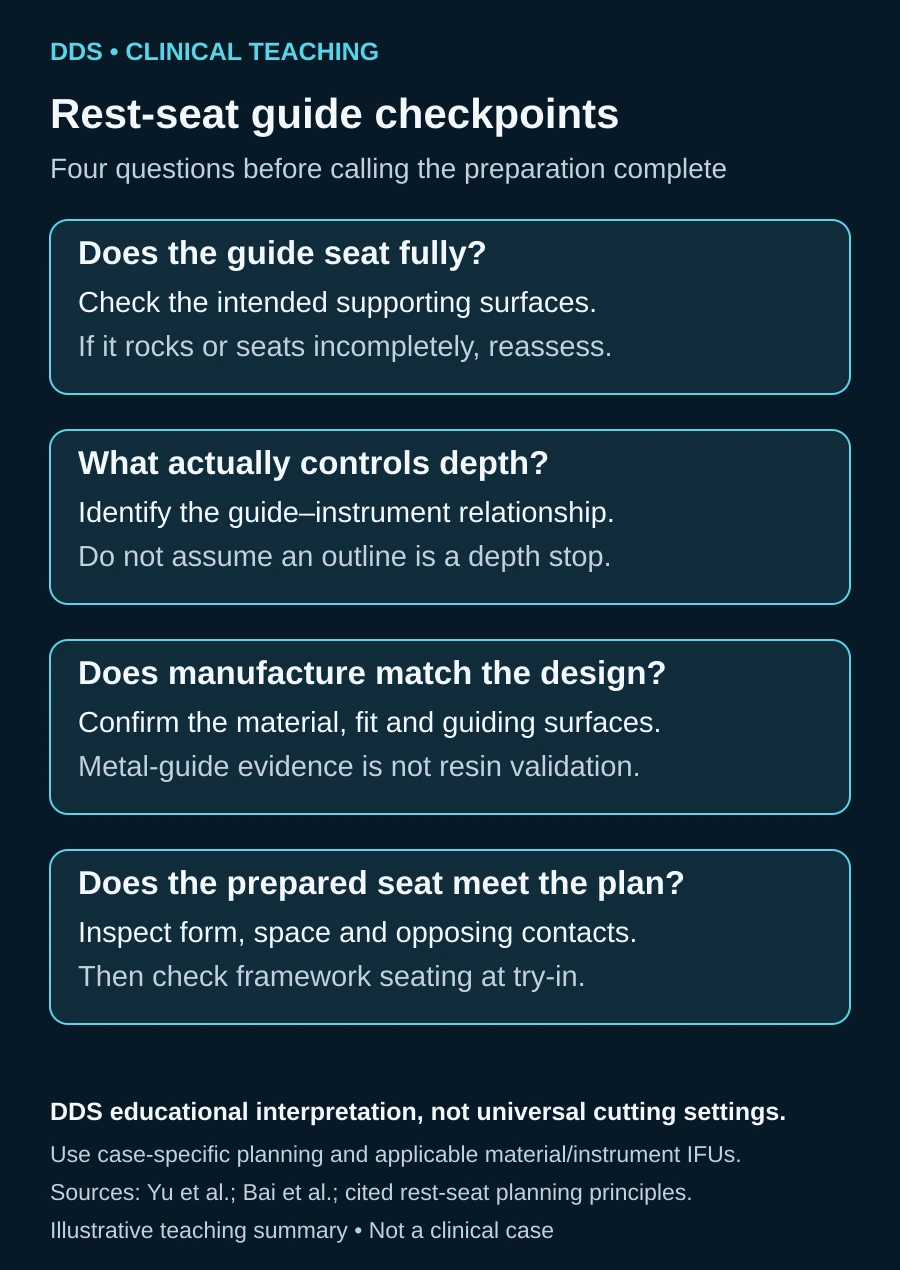
The practical checks below follow from the guide’s dependence on fit and from conventional rest-seat requirements. They are clinical checkpoints, not a claim that the published laboratory workflow has been validated in every patient:- Before preparation: confirm that the guide seats completely and stably on the intended teeth, and that the preparation site, instrument access, and planned depth-control arrangement can be verified. Do not proceed with a rocking or incompletely seated guide.
- During preparation: maintain visibility and appropriate cooling, and reassess the guide if its seating changes or the instrument binds. A guide does not remove the need for operative judgment.
- After preparation: remove the guide and inspect the seat’s position, contour, surface finish, and space for the rest. Check opposing contacts and preserve the intended framework path of placement. Rest-seat assessment principles.
- At framework try-in: verify that the rest and framework seat as intended. A close match to the CAD plan does not by itself confirm clinical fit. Clinical study of rest-seat adaptation.
When does a guide add value?
Digital planning can make the intended preparation easier to review and communicate. It also introduces design, manufacturing, and fit checks. The decision to use a guide should consider the proposed preparation, access, team experience, and the work needed to produce and verify it.For rest-seat preparation, the evidence discussed here supports feasibility and laboratory accuracy. The reports discussed here do not establish better patient comfort, lower total cost, or longer prosthesis survival. The clinical goal remains a well-supported RPD with appropriate rest-seat form, adequate restorative space, and verified fit.What should the dentist and laboratory agree before preparation?
- Dentist: approve the RPD design, abutment condition, available space and proposed preparation before guide manufacture.
- Laboratory: confirm the guide material, instrument relationship, manufacturing method and inspection requirements for the selected design.
- Together: distinguish guide fit from verified preparation and framework fit. Reassess rocking, poor access or an unclear depth-control arrangement before proceeding.
References and further reading
- Yu H, Wen T, Wu J. Digital design and fabrication of a guiding template for preparing occlusal rest seats in removable partial denture abutments. Journal of Prosthetic Dentistry. 2026;135(1):42–46. Published online March 27, 2025. Dental technique report.
- Bai H, Ye H, Chen H, Jiang D, Zhou Y, Tian S, Sun Y. Accuracy of rest seat prepared by rigid constraint template for removable partial denture: An in vitro study. Translational Dental Research. 2025;1(4):100033. Laboratory comparison.
- Sato Y, Shindoi N, Koretake K, Hosokawa R. The effect of occlusal rest size and shape on yield strength. Journal of Prosthetic Dentistry. 2003;89(5):503–507. Finite element analysis.
- Stern MA, Brudvik JS, Frank RP. Clinical evaluation of removable partial denture rest seat adaptation. Journal of Prosthetic Dentistry. 1985;53(5):658–662.
- Akaltan F. A Guide to Removable Partial Denture Planning. 2025. Occlusal rests and Abutment teeth preparations on enamel. Ankara University educational resource.

WHERE DIGITAL MEETS CLINICAL
Perio-Implantologist
International Digital Dentistry Speaker
Digital Occlusion Consultant
Founder of DDS
Founder of Occlusa AI Platform
 h.sharshar@ddschoology.com
About Dr. Haitham Sharshar
Dr. Haitham Sharshar is an international digital dentistry speaker, educator, and digital occlusion consultant based in Cairo, Egypt. His work focuses on functional digital dentistry, CAD/CAM, implantology, jaw-motion analysis, and the integration of digital diagnostics into clinical treatment planning.
As Founder and Scientific Coordinator of Digital Dentistry Schoology (DDS), he has trained more than 3,270 dentists and dental technicians through university programs, international conferences, and hands-on courses. His teaching connects patient-specific diagnostic records with digital design and clinical workflows, helping clinicians and technicians understand how function and occlusion inform restorative planning.
Dr. Sharshar is a certified trainer for zebris JMA-Optic+ jaw-motion analysis and MyoWise dental EMG. His educational and consulting work brings together patient diagnostics, jaw-motion records, muscle-activity data, digital occlusion, and AI-supported workflows.
He is Founder and Clinical Director of Occlusa, an AI-supported platform for organizing clinical information and supporting clinician-led review and treatment planning. He also owns HS Dental Clinic in Cairo, where his clinical focus includes full-mouth digital rehabilitation and smile design.
His speaking and training topics include functional digital dentistry, digital occlusion, jaw-motion analysis, CAD/CAM workflows, digital implantology, and the practical integration of AI-supported tools into dental education and clinical practice.
Happy to collaborate on spreading digital dentistry.